Packaging Printing in Riyadh: A Buyer’s Guide for Brands and Manufacturers
The seven decisions behind every packaging order, in the sequence they actually get made — formats, board, print method, dielines, sampling, tooling and lead times.

Ordering packaging is not ordering print. That is the thing nobody tells you before your first quote comes back with questions you cannot answer.
With brochures, you send a file and receive brochures. With packaging, before anything is printed, someone has to decide the structure, the board, the print method, the finish, the die, the assembly method, and whether the thing survives a truck to Jeddah in August. Those decisions are made in a specific order, and each one constrains the next. Choose the board before the structure and you will redo the structure.
This guide walks the decisions in the order they actually get made, so you arrive at your first conversation with a Riyadh packaging supplier knowing what you are being asked.
First: which of the five formats is your product in?
Everything downstream depends on this. Most confusion in packaging quoting comes from a buyer saying “boxes” when they mean one of five genuinely different manufacturing processes.
| Format | What it is | Typical products | Print method |
|---|---|---|---|
| Folding carton | Single-layer paperboard, printed flat, die-cut, creased, glued, ships flat | Cosmetics, pharma, dates, confectionery, retail consumer goods | Offset, or digital for short runs |
| Corrugated box | Fluted board between liners, built for strength and transit | Shipping cartons, e-commerce mailers, bulk outer cases | Flexo direct, or litho-laminated for retail quality |
| Rigid box | Thick greyboard wrapped in printed paper, does not fold flat | Perfume, watches, luxury gifting, premium electronics, corporate gifts | Offset-printed wrap, applied by hand or machine |
| Labels and sleeves | Printed substrate applied to an existing container | Bottles, jars, cans, tubs, sachets | Flexo, digital, or offset depending on run |
| Flexible pouches | Laminated film structures, stand-up or flat | Coffee, snacks, spices, pet food, powders | Rotogravure at volume, digital at low volume |
A fair number of products need two of these at once. A skincare brand typically needs a folding carton for the unit, a label for the bottle inside it, and a corrugated outer for shipping. Those are three separate specifications, three separate dies, and often three different production lines. Quote them together or the shipping carton becomes an afterthought that arrives two weeks late.
Second: the board decision
Board is where cost, appearance, and structural performance all get decided simultaneously. The vocabulary matters because suppliers use it as shorthand.
For folding cartons
- FBB, folding boxboard. Multi-layer, bright, excellent creasing and folding behaviour. The default for cosmetics and pharmaceutical cartons
- SBS, solid bleached sulphate. Bleached white throughout, including the reverse. Premium feel, used where the inside of the box is visible or where food contact matters
- CCNB or greyback. Coated white front, grey recycled reverse. Substantially more economical and entirely adequate for many retail cartons, but the grey interior shows when the box opens
- Kraft and uncoated. Natural brown or uncoated white, chosen deliberately for a craft or sustainability aesthetic. Prints with a softer, muted result
For corrugated
Flute grade is the specification to know. It describes the wave layer inside:
- E flute — roughly 1.5mm, fine and smooth, prints well, used for retail-facing small boxes and e-commerce mailers
- B flute — roughly 3mm, the general-purpose workhorse
- C flute — roughly 4mm, more cushioning, standard for shipping cases
- BC double wall — two layers combined, for heavy or export loads
For rigid boxes
The structure is greyboard, typically 1mm to 3mm thick, and it is not printed. The printed element is the paper wrap applied over it. This is why rigid boxes feel entirely different to specify: you are choosing a board thickness for rigidity and a separate printed wrap for appearance.
Ask for a board sample before approving anything
Board choice is the single decision buyers most often regret, and it cannot be judged from a name or a number. A physical swatch of the actual stock, in your hand, takes one visit and prevents the most expensive category of reprint.
Third: print method, which depends on your run length
This is where packaging meets the general offset-versus-digital question, with two additions specific to packaging.
- Offset dominates folding cartons at commercial volume. Plates carry a fixed setup cost, so per-unit cost falls steeply with quantity, and offset delivers the exact Pantone brand colours that packaging almost always demands
- Digital makes short runs, test launches, seasonal variants, and regional versions viable. No plates, no die investment if you use a plotter-cut sample route, and personalised or multi-version runs become possible
- Flexo prints directly onto corrugated. Robust and economical, but coarser than offset. Correct for shipping cartons, insufficient for a carton that sits on a retail shelf
- Litho lamination is the bridge: print offset onto a paper sheet, then laminate that sheet to corrugated board. This is how retail-quality printed corrugated is made, and it is the answer whenever someone wants shelf-grade graphics on a corrugated structure
The practical rule is the same as elsewhere in print. Short runs go digital, volume goes offset, and the crossover sits in the hundreds rather than the thousands for packaging because die and setup costs are higher. For the full reasoning on where that line falls, see our guide on offset versus digital printing.
Fourth: two kinds of design, and they are not the same job
This distinction causes more delays than any other.
Structural design produces the dieline: the flat, unfolded engineering drawing showing cut lines, crease lines, glue tabs, tuck flaps, and locking features. It determines whether the box closes properly, holds its contents, stacks without crushing, and can actually be assembled by a person in a reasonable time.
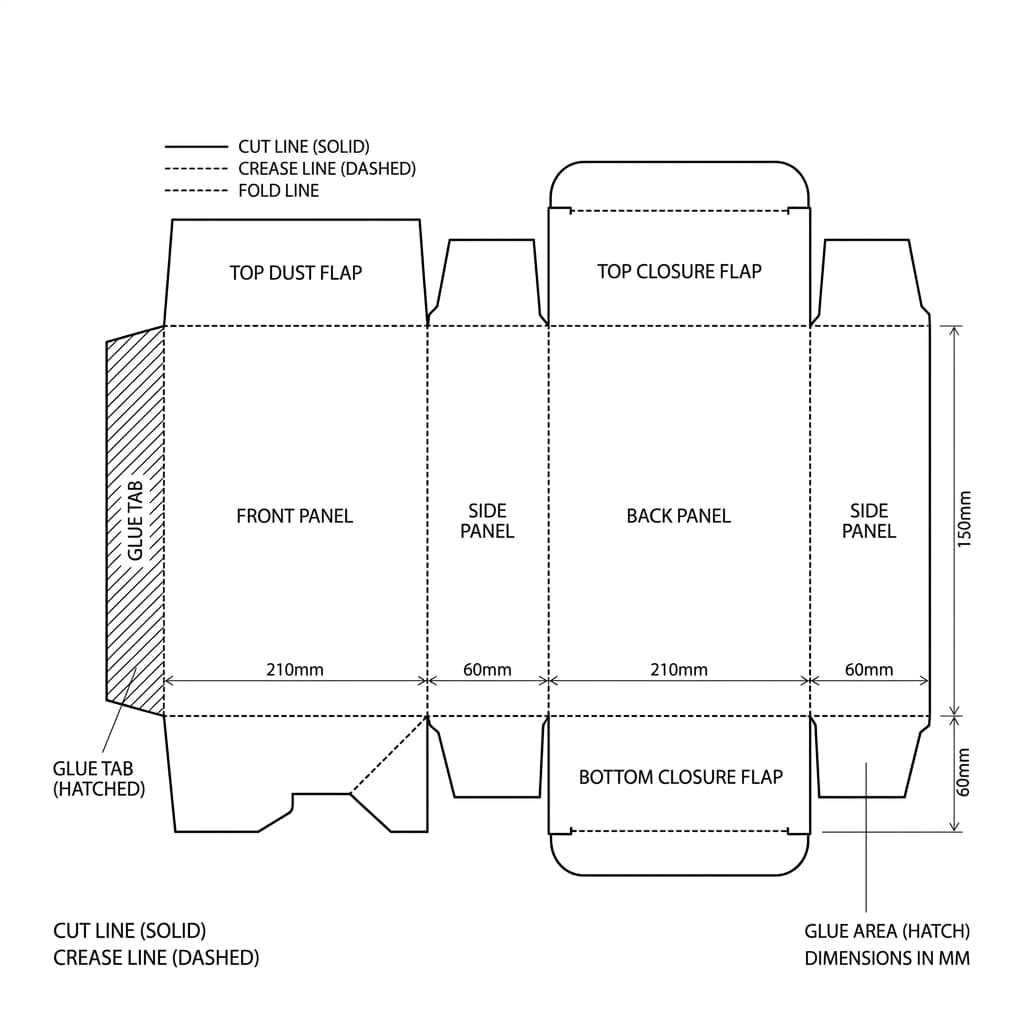
A typical packaging dieline showing solid cut lines and dashed crease lines.
Graphic design is the artwork applied to that dieline: your brand, imagery, copy, and mandatory information.
You cannot do the second before the first exists. Artwork designed on a guessed shape will not fit a real die, and the panel your logo sits on may turn out to be a glue flap. Get the dieline first, design onto it, and keep the cut and crease layers intact in the file you supply.
Standard structures such as a straight tuck end, reverse tuck end, or crash-lock base carton have established dielines that a supplier can provide immediately. A custom structure needs drawing, and that is a design step with its own timeline.
Fifth: sampling, and why you should insist on it
Packaging is three-dimensional and your screen is not. There are four distinct stages of sample, and they answer different questions.
| Sample type | What it proves | What it does not prove |
|---|---|---|
| Digital proof (PDF on screen) | Content, layout, text accuracy, barcode placement | Nothing physical. Colour on screen is not colour on board |
| White sample (unprinted, cut and folded) | Structure, fit, assembly, whether your product goes in | Nothing about appearance |
| Plotter-cut sample (digitally printed, knife-cut) | Structure and appearance together, without die cost | Exact production colour, and true die-cut edge quality |
| Production sample (from the actual run setup) | Everything, on the real press and real die | Only available once you have committed to tooling |
Skipping the white sample is the classic mistake. Approving a beautiful plotter-cut sample only to find the product is 2mm too tall for the carton is a discovery worth making before ten thousand of them exist.
Sixth: minimum order quantities, and why they are not arbitrary
Packaging MOQs frustrate first-time buyers, but the reason is mechanical rather than commercial.
Before the first box is made, someone has to build a cutting die, also called a forme: a plywood board with steel cutting and creasing rules set into it, shaped to your exact structure. That is a physical tool, made once per structure, and it costs the same whether you run five hundred boxes or fifty thousand. Add printing plates for offset, plus a gluing setup, and there is a real fixed cost before any output.
This leads to three useful conclusions:
- Keep your die. Once made, the same tool serves every future run of that structure. Reorders are dramatically simpler than first orders. Ask who stores the die and confirm it is retained.
- Use standard structures where you can. A standard tuck-end carton may need no new die at all.
- Digital short runs exist for a reason. For a launch, a test market, or a pitch, a digitally printed plotter-cut run avoids tooling entirely. It costs more per unit and is the correct choice anyway when you are still validating the design.
Seventh: realistic lead times
Packaging timelines are longer than print timelines, and the reason is that approval stages sit between production stages. The waiting is often yours, not the supplier’s.
| Stage | Typical duration | Who holds it up |
|---|---|---|
| Structural design and dieline | 1 to 3 days for standard, longer for custom | Supplier, then your approval |
| Artwork onto dieline | Depends entirely on your design resource | You |
| Prepress and digital proof | 1 to 2 days | Supplier |
| White or plotter-cut sample | 2 to 5 days including courier | Supplier, then your approval |
| Die manufacture | 3 to 7 days | Toolmaker |
| Printing | 2 to 5 days depending on method and run | Supplier |
| Finishing, lamination, foil, spot UV | 2 to 4 days, varies by process | Supplier |
| Die-cutting and gluing | 2 to 4 days | Supplier |
| Delivery across Riyadh | Same day to 2 days | Logistics |
These are market-typical stage durations, not a commitment. What you should extract from the table is the shape of the timeline: a first packaging order is a multi-week project, and a reorder from existing tooling is a matter of days. Plan launches accordingly, and be honest with yourself about how long artwork approval takes inside your own organisation, because that is usually the longest line item.
Tooling is the milestone that matters
Everything before the die is made can still change cheaply. Everything after it cannot. Front-load your scrutiny onto the dieline and the physical sample, and the rest of the process becomes routine.
Finishing: where packaging earns its price
On a carton, finishing is not decoration. It is most of the perceived value, and it is also functional.
- Matte or gloss lamination — a plastic film that protects against scuffing in transit and handling. Matte reads as premium and shows fingerprints less
- Soft-touch lamination — a velvety tactile finish, heavily used in cosmetics and fragrance
- Spot UV — high-gloss varnish on selected areas only, most effective over matte lamination where the contrast is visible
- Hot foil stamping — genuine metallic gold, silver, or coloured foil. Nothing printed reproduces it
- Embossing and debossing — raised or recessed relief, felt before it is seen
- Window patching — a clear film panel so the product is visible. Adds a step and a material, and changes the structure
- Varnish, aqueous or UV — lighter protection than lamination, more economical, and recyclable more easily
A useful sequencing note: finishing choices constrain each other. Foil does not adhere well over some laminations, spot UV needs a compatible base, and window patching affects where creases can fall. Raise all of your finishing intentions at the quoting stage rather than adding them later.
Compliance in Saudi Arabia: what must appear on the pack
Packaging carries legal obligations that brochures do not. Get this wrong and product is held, relabelled, or rejected.
- Arabic is required. Consumer product information must appear in Arabic. Bilingual Arabic and English packaging is the norm, and Arabic is not a translation afterthought. It changes panel layout, text volume, and reading direction
- SFDA-regulated categories. Food, beverages, cosmetics, supplements, medical devices, and related products fall under Saudi Food and Drug Authority requirements covering mandatory declarations, ingredient and nutrition information, production and expiry dating, storage conditions, and origin. Requirements differ meaningfully by category
- Barcodes. Retail distribution needs a valid GS1 barcode, correctly sized, with adequate quiet zone and sufficient contrast against its background. A barcode printed too small, reversed out, or placed over artwork is a genuine scanning failure at till
- Traceability marking. Batch codes, lot numbers, and dating are usually applied by you after delivery, which means the pack must include a designated clear area for them
Confirm current requirements for your specific product category with the SFDA or a compliance consultant before print. Regulations are updated, they vary by category, and a printer is not a regulatory authority. Any supplier who tells you otherwise is overreaching.
How to brief a packaging supplier properly
Bring these and your first quote will be accurate rather than provisional:
- The product itself, or its exact dimensions and weight. Packaging is designed around a physical object
- Quantity, and whether it is one order or an annual volume broken into releases. Annual volume changes the economics
- Format, from the five above, or a description of the problem if you are unsure which
- Where it will be sold. Retail shelf, e-commerce shipping, gifting, and export each impose different structural requirements
- Shipping and stacking needs. How it travels, how high it stacks, whether it is palletised
- Brand colours, as Pantone references rather than screen values
- Finishing intentions, all of them, upfront
- Your deadline, and which date is real: production, warehouse arrival, or launch
- Compliance category, so mandatory content space is planned rather than squeezed in later
The four mistakes that cost the most
- Designing artwork before the dieline exists. The artwork gets rebuilt. Sometimes twice.
- Approving on screen. Colour on a monitor is emitted light. Colour on board is reflected light on a specific substrate with a specific coating. They do not match, and a matte laminated surface will read darker than your screen suggested.
- Forgetting the shipping carton. The retail pack gets months of attention and the outer case gets specified in a panic the week before dispatch, usually at the wrong flute grade.
- Ordering a first run at test-market quantity, then reordering at test-market quantity again, and again. The tooling is already paid for. Once the design is validated, consolidating volume into fewer, larger runs is where packaging economics actually work in your favour.
Frequently asked questions
What packaging printing services are available in Riyadh?
Riyadh suppliers cover five main formats: folding cartons for retail unit packaging, corrugated boxes for shipping and e-commerce, rigid boxes for luxury and gifting, labels and sleeves for bottles and containers, and flexible pouches for food and powders. Each uses a different manufacturing process, so confirm which formats a supplier produces in house rather than brokers out.
What is a dieline and why do I need one before designing?
A dieline is the flat engineering drawing of your packaging, showing every cut line, crease line, and glue tab before the structure is folded. Artwork must be designed onto the actual dieline, because designing onto a guessed shape produces artwork that does not align with the real die and often places key elements on glue flaps or fold lines.
What is the minimum order quantity for custom boxes?
MOQs exist because a physical cutting die must be manufactured before the first box is produced, and that tool costs the same regardless of run length. Offset folding cartons carry the highest minimums, while digitally printed plotter-cut runs can be produced in small quantities without tooling, which makes them suitable for launches and test markets.
Which board should I choose for a folding carton?
Folding boxboard is the general default for cosmetics and pharmaceutical cartons because it creases and folds cleanly. Solid bleached board is used where the interior is visible or food contact matters. Coated recycled board with a grey reverse is more economical and suitable for many retail cartons, though the grey interior is visible when opened.
What is the difference between flexo and litho-laminated corrugated printing?
Flexo prints directly onto corrugated board and is economical and durable, but graphically coarser, making it right for shipping cartons. Litho lamination prints offset onto a paper sheet which is then bonded to the corrugated board, delivering retail shelf quality graphics on a corrugated structure at higher cost.
How long does a custom packaging order take in Riyadh?
A first order is a multi-week project because structural design, artwork, proofing, physical sampling, die manufacture, printing, finishing, die-cutting, and gluing each take days and approval stages sit between them. Reorders from existing tooling are far faster, typically a matter of days, since the die and plates already exist.
Does packaging in Saudi Arabia have to be in Arabic?
Yes, consumer product information must appear in Arabic, and bilingual Arabic and English packaging is standard practice. Arabic content should be planned into the layout from the start rather than added late, because it affects panel space, text volume, and reading direction. SFDA-regulated categories carry additional mandatory declarations.
Can I reuse my packaging die for future orders?
Yes, and you should. A cutting die is a physical tool that remains usable for every future run of the same structure, which is why reorders cost less and move faster than first orders. Confirm with your supplier who stores the die and that it is retained rather than discarded after the run.
What is the difference between a rigid box and a folding carton?
A folding carton is single-layer paperboard that is printed, die-cut, creased, and shipped flat to be assembled later. A rigid box uses thick greyboard that holds its shape permanently, wrapped in separately printed paper, and cannot be flat-packed. Rigid boxes cost considerably more and are used for luxury, fragrance, and premium gifting.
Start with your product, not a price
Send Golden Arch Printing your product dimensions, your quantity, where it will be sold, and your deadline. You will get a recommended format and structure, a dieline to design onto, and a physical sample before anything is committed to tooling.
If your packaging needs a format we do not produce in house, we will tell you that directly rather than brokering it quietly.
Request a packaging consultation